 Teknik Industri | Fakultas Teknik Universitas Andalas
Teknik Industri | Fakultas Teknik Universitas Andalas
Teknik Industri | Fakultas Teknik Universitas Andalas


Program Educational Objectives (Profil Profesi Mandiri) is broad statements that describe the career and professional accomplishments that the program is preparing graduates to attain within a few years after graduation. The Program Educational Objectives were first established in 1994 when the Industrial Engineering Program was established. As the curriculum is updated every 5 years, the Program Educational Objectives are also updated. The last Program Educational Objectives from the 2013 Curriculum are consisted of four objectives. In October 2015, after attending the Leadership Engineering Education on Accreditation Program (LEEAP) training workshop, the Program Chair and Curriculum Team proposed minor changes to the Program Educational Objectives to be in-line with ABET accreditation requirements, which were submitted to the constituencies for review and approval by the faculty. The constituencies of the Industrial Engineering program are students, faculty, alumni, and employers (as Industrial Advisory Board-IAB). The revised statements are consisted of five Program Educational Objectives and they are adopted starting in January 2016.
In Mei 2017 as revised in December 2017, the formal Industrial Advisory Board (IAB) was established by Department of Industrial Engineering through the Decree of Dean of Engineering Faculty No. 255A/XIII/i/FT-Unand/2017. On March 3, 2018 the Industrial Advisory Board (IAB) organized the first regular meeting at Department of Industrial Engineering to review the Program Educational Objectives. These Program Educational Objectives had been approved by the program. Establishment of the Program Educational Objectives has already considered resources, culture and nation needs and interests and also directly support the vision and mission of the University.
The Program Educational Objectives (Profil Profesi Mandiri) of Industrial Engineering Program, Andalas University are; two-three years after graduation the graduates are expected to attain these below in their earlier career. (Profil Profesi Mandiri Program Studi S1 Teknik Industri, Universitas Andalas adalah; dua-tiga tahun setelah menyelesaikan studi (lulus), lulusan diharapkan memiliki hal-hal berikut dalam awal kariernya.)
1. Graduates are expected to attain professionalism and leadership role within industrial organization or other related organization
(Lulusan diharapkan memiliki profesionalisme dan peran kepemimpinan dalam organisasi industri atau organisasi lainnya yang relevan.)
2. Graduates are expected to attain role as the source for efficient and value added solutions to increase the benefit of the organization
(Lulusan diharapkan memiliki peran sebagai sumber solusi yang efisien dan bernilai tambah untuk meningkatkan manfaat organisasi)
3. Graduates are expected to have demonstrated the applications of cost, quality, and delivery improvement tools to achieve global competitive advantages
(Lulusan diharapkan telah menerapkan aplikasi dari teknik-teknik perbaikan kualitas, biaya dan delivery untuk meraih keunggulan bersaing secara global)
The carier paths of the graduates of Industrial Engineering program in industrial organization and other related organization may be as; consultants, contractors, lecturers, researchers, policy and decision makers and managers or staff.(Jalur karier lulusan Program Studi S1 Teknik Industri dalam organisasi industri dan organisasi lain yang relevan dimungkinkan sebagai; Konsultan, Kontraktor, Dosen, Peneliti, Pembuat dan Pengambil Kebijakan, Pelaksana Kebijakan)
Hasil sosialisasi Program Educational Objectives (Profil Profesi Mandiri) ini memberikan pengaruh terhadap mutu pembelajaran yaitu dengan adanya profil profesi mandiri ini, seluruh stakeholders memberikan masukan terhadap peningkatan mutu pembelajaran termasuk mahasiswa melalui kuesioner. Masukan tersebut kemudian diimplementasikan dalam bentuk tindakan perbaikan dalam proses pembelajaran berdasarkan hasil asesmen atau pengukuran capaian pembelajaran program studi
TTD
Admin Web JTI
Accredited by:
 Peringkat "Unggul", No. SK. 6094/SK/BAN-PT/Akred-Itnl/S/IX/2020
Industrial Engineering Undergraduate Program:
Industrial Engineering Program at Andalas University was established in 1994 as a concentration in Mechanical Engineering Program. In 1996, the Industrial Engineering program officially started as one program of study in Engineering Faculty. IE has been accredited three times by the National Accreditation Board for Higher Education in Indonesia and for the latest result of accreditation that were announced on October 31, 2015, IE got a score of 365 (range 0-400) and therefore eligible for grade “A” (highest rank) and finally, eligible for grade "Unggul" since September 29, 2020 . In December 2018, IE provisionally accredited by IABEE (Indonesian Accreditation Board for Engineering Education), the International Accreditation Board of Indonesia for Engineering Education. Finally, In October 2020, IE fully accredited by ABET (Accreditation Board for Engineering and Technology), the Accreditation Board of USA for Engineering and Technology.
Industrial Engineering program is the branch of engineering which is concerned with the design, improvement and installation of integrated systems of people, materials, information, equipment and energy. It draws upon specialized knowledge and skill in the mathematical, physical, and social sciences together with the principles and methods of engineering analysis and design, to specify, predict, and evaluate the results to be obtained from such systems.
Industrial engineering discipline is unique because it combines fundamental topics in mathematics, physical and engineering sciences knowledge with the principles and methods of engineering analysis and design to design, improve and install that integrated system. Human factor is the central factor to solve the problems in the system. The Industrial Engineering curriculum at UNIVERSITAS ANDALAS is designed to encourage graduates those are able to develop the knowledge, skill and attitude gained by study in their career in companies and also to practice them through entrepreneurship and intrapreneurship experience.
The study program emphasizes the application of industrial engineering science and design combined with specialized engineering and general sciences in a balanced treatment of theory, case study and experience through teaching learning process. Computer applications are integrated throughout the curriculum. Some of the core courses require the students to have lab and computerized activities. The laboratories are available for students to use during their study are but not limited to: Basic Science Lab, Manufacturing Process Lab, Material Lab, Work System Design and Ergonomics Lab, Production System Lab, Plant Facilities Layout Lab, Information System and Decision Lab, Industrial System Planning and Optimization Lab and Business and Management Lab and Multimedia Room. (Catalog 2018/2019, Catalog 2019/2020, Catalog 2020/2021,Catalog 2021/2022, Catalog 2022/2023, Catalog 2023/2024)
Scientific Vision (Visi Keilmuan):
Becoming an internationally recognized Industrial Engineering Undergraduate Program (Menjadi Program Studi Sarjana Teknik Industri yang bereputasi internasional)
TTD
Admin Web JTI

Chair of Department

Dr. Eng. Dicky Fatrias, ST, M.Eng
Secretary of Department

Feri Afrinaldi, ST, M.Eng, PhD
Chair of Undergraduate Program (S1)

Dr. Eng. Desto Jumeno, ST, MT
Chair of Postgraduate Program (S2)
EXECUTIVES
Chair of Department of Industrial Engineering:
Ir. Elita Amrina, ST, M. Eng, Ph.D, IPU, ASEAN Eng
Secretary of Department of Industrial Engineering:
Dr. Ir. Prima Fithri, ST, MT
PROGRAM CHAIRS
Chair of Bachelor Program of Industrial Engineering:
Ir. Reinny Patrisina, Ph.D
Secretary of Bachelor Program of Industrial Engineering
Dr. Ir. Dina Rahmayanti, M.Eng
Chair of Master Program of Industrial Engineering:
Dr. Eng. Desto Jumeno, ST, MT
Chair of Doctoral Program of Industrial Engineering
Ir. Feri Afrinaldi, Ph.D
RESEARCH GROUPS
Chair of Human Factor Engineering (HFE) Research Group:
Ir. Hilma Raimona Zadry, ST, M.Eng, Ph.D
Chair of Manufacturing System (MS) Research Group:
Dr. Alfadhlani, ST, MT
Chair of Engineering Management System (EMS) Research Group:
Ikhwan Arief, M.Sc
Chair of Logistics and Supply Chain System (LSCS) Research Group:
Prof. Dr. Ir. Rika Ampuh Hadiguna, ST, MT, IPU
LABORATORIES
Head of Production System Laboratory:
Ir. Jonrinaldi, ST, MT, Ph.D, IPU, ESLog
Head of Work System Design and Ergonomics Laboratory:
Dr. Eng. Lusi Susanti, ST, M.Eng
Head of Information System and Decision Laboratory:
Asmuliardi Muluk, MT
Head of Industrial System Design and Optimization Laboratory:
Eri Wirdianto, M.Sc
Head of Business and Management Laboratory:
Prof. Dr. Ir. Alizar Hasan, MSIE, M.Eng
Head of Facilities Layout Design Laboratory:
Dr. Alfadhlani, ST, MT
COORDINATORS
Coordinator of Research and Community Service:
Dr. Ir. Dina Rahmayanti, M.Eng
Coordinator of Reading Room:
Dr. Alexie Herryandie Bronto Adi
ADMINISTRATIVE STAFF
General Staff:
Arman, SH
Academic Administrative Staff for Undergraduate Program:
Merry Nursanti
Academic Administrative Staff for Postgraduate Program:
Ardi Sopia, S.Kom
Technician/Lab Staff:
Reading Room/Library Staff:
Frans
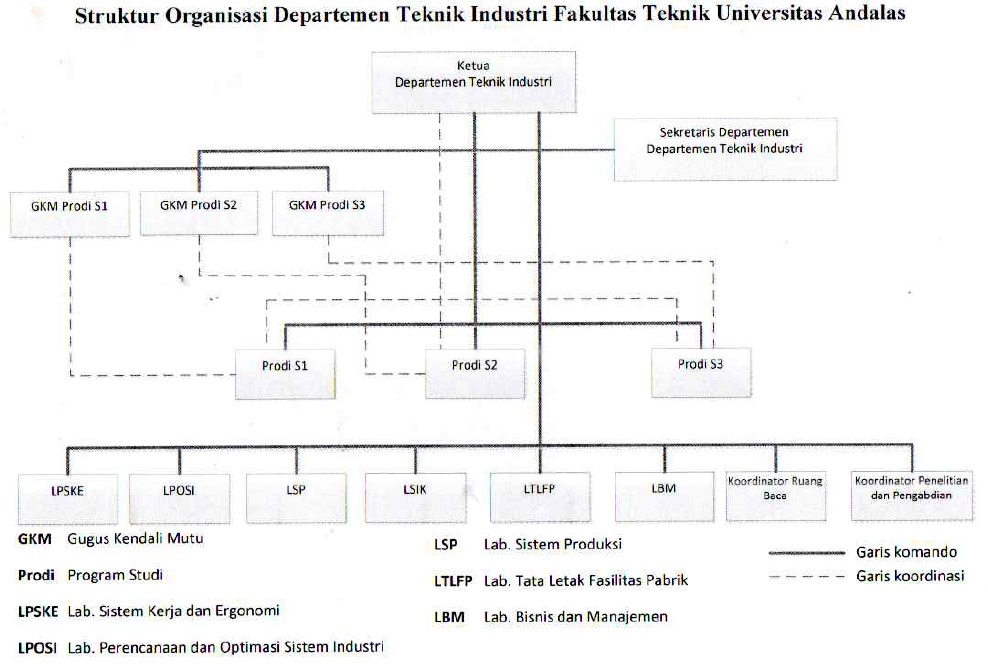
Struktur Organisasi dan Tata Kelola Departemen Teknik Industri selengkapnya, silahkan klik link ini dan Prosedur Operasi Standar (SOP) bisa diklik link ini.
ORGANIZATION STRUCTURE OF DEPARTMENT OF INDUSTRIAL ENGINEERING
FACULTY OF ENGINEERING, UNIVERSITAS ANDALAS
Updated: April 2024


Prodi Teknik Industri Universitas Adzkia - Website: https://ti.adzkia.ac.id/